
What is a home care virtual assistant?
Every home care visit creates office work before the caregiver arrives and after they leave. Here's where a remote assistant fits and what stays with your team.
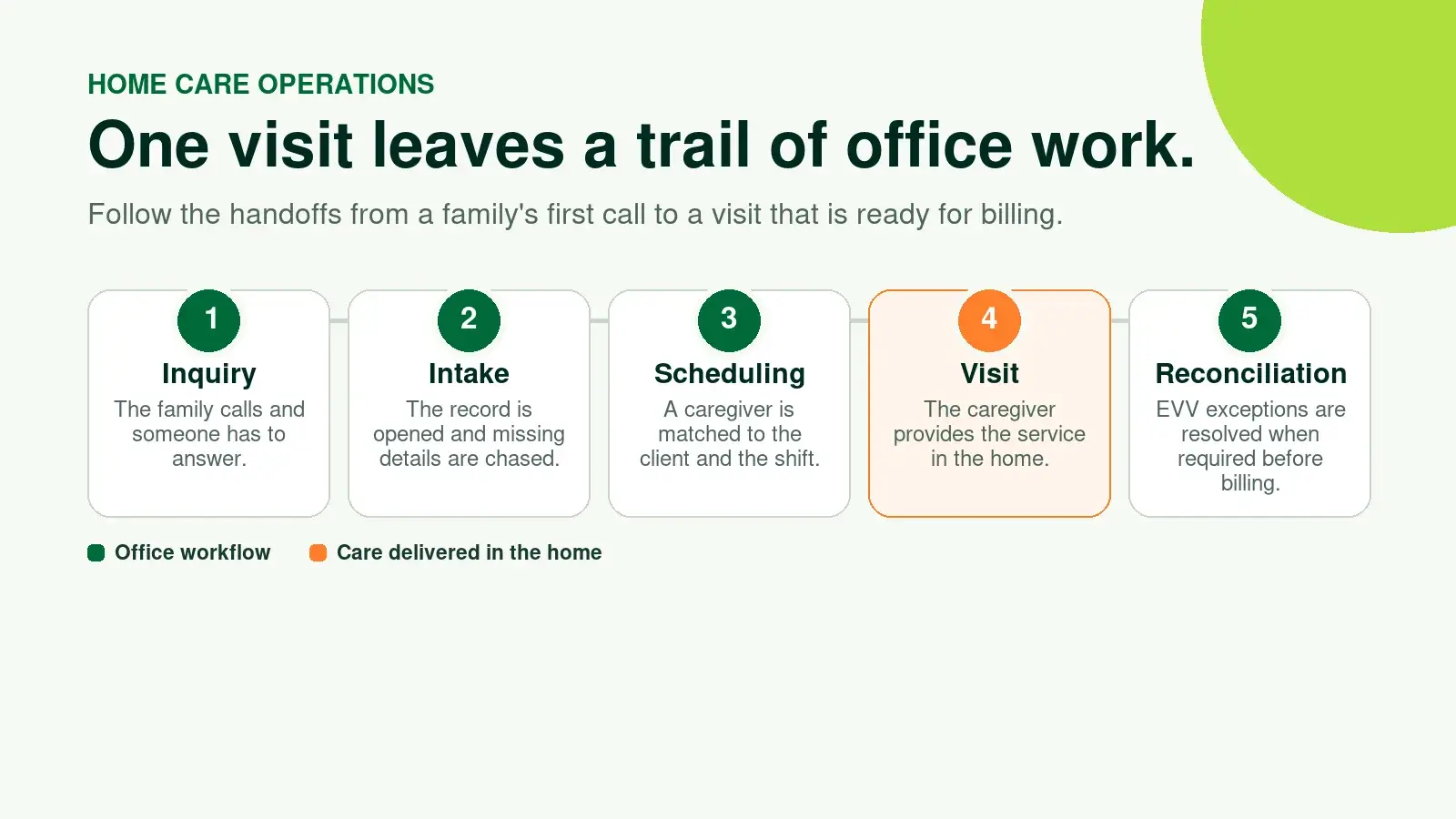
Consider a common call. A daughter phones a home care agency because her father needs help three mornings a week, and she wants to know who will come and how soon service can begin.
Before a caregiver reaches the front door, someone in the office has to return that call and build a record, then find an available caregiver while keeping the family updated. After the visit, the record has to match the schedule, a missed clock-out may need follow-up, and billing may be waiting on a clean handoff. A home care virtual assistant is a remote person who carries a defined part of that non-clinical office work.
Intake: turning the first call into a record
The first call rarely arrives as a complete file. Someone has to capture the details, from contact information and preferred hours to payer information when relevant, then chase what’s missing and tell the family what happens next.
A remote intake coordinator can take that call, enter the information into your system, and work the checklist until the next step is scheduled. Your qualified staff still decide eligibility and whether to accept the client, along with anything that depends on an assessment or clinical judgment.
Scheduling: matching an approved caregiver
Once service is approved, the work shifts to coverage: an available caregiver near the client who fits the requested hours, ideally someone who has worked with them before, and who meets any preferences or required qualifications.
A remote scheduler can do this from a cleared roster your agency has approved, in the platform you already use, whether that’s AxisCare, WellSky or HHAeXchange. They apply your documented rules, including authorization, then update the board, confirm assignments and record changes. Any match or exception you reserve for qualified staff goes to them.
EVV: resolving visit exceptions
For Medicaid-funded personal care and home health services that require an in-home visit, federal law requires states to use electronic visit verification. Day to day, that can leave an exception when a clock-in is late, a clock-out is missing, or the recorded visit doesn’t match the schedule.
A remote EVV coordinator can monitor those exceptions, check each against the scheduled visit, and contact the caregiver for anything missing, then document what happened and route the item through your approved correction process. State rules, payer requirements and agency policy determine what may be changed and who approves it.
When a family asks why a visit is missing from an invoice, the same person may be able to find the schedule and timestamp. Claims work, from coding through denials and payment follow-up, belongs to billing and should be scoped as billing work. Our guide to a healthy revenue cycle covers that work in more detail.
What is a home care virtual assistant?
A home care virtual assistant is a person who works remotely on a defined, non-clinical workflow for a home care agency, inside the agency’s own systems and procedures and with clear escalation paths. Besides the intake, scheduling and EVV work above, that can include recruiting coordination or documentation follow-up.
The assistant is a human team member. Software can help with reminders, alerts and automation, while the person handles the communication, exceptions and handoffs that need context.
The schedule may also reveal a capacity problem: too few caregivers, applicants waiting for a response, or interviews sitting unscheduled. A recruiting coordinator can keep applicants moving from the job post to a booked interview, while the hiring decision stays with the agency.
Each role ends at a clear handoff to your staff:
| Role | Work they can carry | Typical handoff |
|---|---|---|
| Intake coordinator | New inquiries, data collection, record setup, missing-item follow-up | Assessment, service acceptance, or eligibility decision |
| Scheduler | Open shifts, call-outs, confirmations, and assignments from an approved roster using documented rules | Safety, clinical, staffing, or unresolved coverage escalation |
| Recruiting coordinator | Job posts, applicant follow-up, first screens, interview calendar, document tracking | Interview evaluation and hiring decision |
| EVV coordinator | Exception monitoring, caregiver follow-up, documentation, approved corrections | Supervisor review or billing cutoff |
Home care or home health: which work are you staffing?
Search results often mix home care with home health, medical practices and general virtual assistance. Here, home care means the agency model: clients receiving personal care or support at home, caregivers on scheduled shifts, and an office coordinating the service.
Skilled home health, such as nursing or therapy delivered under clinician-led requirements, runs on different documentation and billing workflows, including orders and assessments. Some organizations operate both. Match each remote role to the work it will actually handle, not to a job description borrowed from a neighboring industry.
What a home care virtual assistant should not decide
The role’s authority is clearest at each handoff: what the assistant can complete, what must be approved, and who receives an exception.
Caregivers provide the service in the home, and licensed clinicians make clinical judgments where the service requires them. Hiring managers choose who joins the workforce, and billing specialists own the work their training and controls authorize. A virtual assistant can prepare, document and escalate around those decisions without quietly inheriting them.
That’s why a job description that says “general admin” creates trouble: it gives the person no clear finish line and gives you no useful way to measure the work. A better scope names the work and the hours of coverage, defines what done means, and says who receives an escalation.
Is a home care virtual assistant HIPAA compliant?
Before the first login
For agencies subject to HIPAA, the controls start with the working relationship and follow the data.
- Classify the workforce or business associate relationship
- Complete the BAA and downstream agreements when applicable
- Provision a unique account with minimum necessary access
- Use approved communication, logging, and incident procedures
- Document offboarding before access begins
Geography does not decide compliance. The working relationship, the information being handled and the safeguards around that work do.
HHS defines a business associate as a person or organization outside a covered entity’s workforce that performs certain functions or services involving protected health information. HHS explains the relationship in its business associate guidance, and the required contract terms appear in 45 CFR 164.504(e).
HIPAA’s workforce definition can include people whose conduct in performing work is under the covered entity’s direct control, such as employees, volunteers and trainees, whether or not they are paid. A remote individual or staffing company operating outside that workforce may be a business associate when handling PHI on the agency’s behalf. In that arrangement, the BAA belongs in place before PHI access, and subcontractors that handle the information must accept the applicable restrictions. Your compliance lead or counsel should confirm the arrangement.
The login itself still needs controls. HIPAA’s technical safeguards require unique user identification and access controls for systems containing electronic PHI, and the Privacy Rule’s minimum necessary standard calls for limiting access to what the role needs. In practice, that means the steps in the checklist above with role-appropriate permissions, plus protections such as multi-factor authentication where appropriate.
A training certificate records one part of onboarding. It doesn’t replace the applicable contract, risk analysis or access design, and the agency still needs supervision and an incident process around the role.
Which home care virtual assistant role should you hire first?
Start with evidence from an ordinary week. Pull the work your team already handles and look for recurring delay.
| What keeps aging? | Role to scope first | What to measure from your baseline |
|---|---|---|
| New inquiries and incomplete start-of-care files | Intake coordinator | Response time, complete records, time to next step |
| Open shifts, call-outs, and owner after-hours calls | Scheduler | Open-shift age, time to coverage, missed visits |
| Applicants waiting for contact or interviews | Recruiting coordinator | Time to first contact, interview show rate, completed files |
| EVV exceptions waiting near the billing cutoff | EVV coordinator | Exception backlog, age, and clean visits by cutoff |
Start with the recurring work that has the oldest unresolved items, and measure it against your own baseline before adopting a vendor’s benchmark. Your call-off volume, payer mix and service area all change what a reasonable target looks like.
What should be ready before the first login?
- One defined workflow. Name the work and write down what complete means.
- Coverage and escalation rules. Set the working hours and response expectations, and name the person who takes unresolved or higher-risk items.
- A usable procedure. Document the steps the role will follow in each system, including scripts and which exceptions need approval.
- Appropriate access. Complete the contract and compliance work that applies, then provision a unique account with the permissions the role needs.
- A baseline and review date. Record where the work stands today, such as the size and age of the backlog or your response time, so you can tell whether the role is improving it.
Our delivery process starts with those same decisions, along with volume, risks and how success will be measured.
Start with one week of your own records
Return to the family who made the first call. What they experience is the callback, the confirmed caregiver and accurate follow-through after the visit, and each of those depends on clear ownership, wherever the office work happens.
Pull one week of records for the area that keeps falling behind. The work with the oldest items is a better starting point than a long list of tasks you hope one person can absorb.
If you want to scope that work with us, book a discovery call and bring the report. We can name the role from the work.